
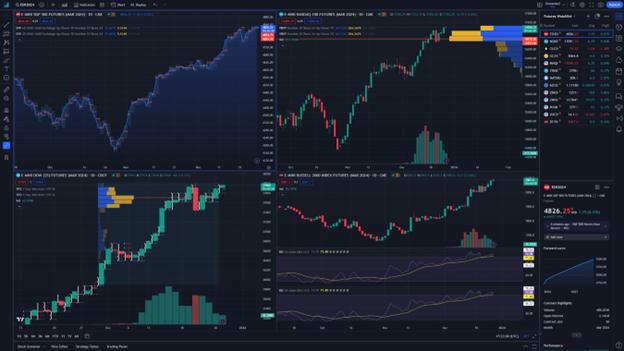
The stock exchange. For many, the term conjures images of frantic traders on a bustling floor, or perhaps the relentless, glowing ticker tape of Wall Street. Yet, the modern stock exchange is far more than a dramatic backdrop for financial thrillers; it is the single most important engine of global capitalism, a sophisticated, high-speed marketplace that determines the value of the world’s largest companies and fuels innovation across every sector.
If you’ve ever wondered how these colossal markets truly function, how they evolved from simple debt trading to the hyper-digitalized platforms of today, and what forces—like the rise of Artificial Intelligence—are shaping their future, you’ve come to the right place. We will break down the complex mechanics of the exchange, examine its staggering scale, and offer a glimpse into the volatile, interconnected world of modern finance.
The Foundation: What an Exchange Really Does
At its core, a stock exchange is simply a marketplace where buyers and sellers meet to trade securities, such as stocks, bonds, and commodities . But its function is twofold, distinguishing between two crucial concepts: the primary and the secondary market.
The primary market is where a company first sells its shares to the public through an Initial Public Offering (IPO). This is the moment a private company raises capital to fund its growth, expansion, or debt repayment. Think of it as the company’s debutante ball.
The secondary market, which is what most people refer to when they talk about the “stock market,” is where investors trade those shares after the IPO . This is the daily grind of buying and selling between investors, not with the company itself. This secondary market is vital because it provides liquidity—the ability to quickly and easily convert an asset into cash—which is what makes the primary market attractive in the first place. Without the assurance that you can sell your shares later, no one would buy them initially.
The concept of a centralized marketplace for debt and equity is not new. Its origins can be traced back to 13th-century Venice, where merchants traded government debts . The first true modern stock exchange, however, was established in 1602 in Amsterdam by the Dutch East India Company, creating a model for the New York Stock Exchange (NYSE), which itself traces its roots to the 1792 Buttonwood Agreement . The evolution from physical trading floors with “open outcry” to the fully electronic systems of today marks a profound shift, transforming the exchange from a physical location into a high-speed digital network .
The Global Titans: Scale and Statistics
To appreciate the significance of the stock exchange, one must grasp its sheer scale. The world’s largest exchanges command market capitalizations that dwarf the GDP of most nations. As of mid-2025, the two titans of the industry, both based in the United States, illustrate this colossal scale:
| Rank | Stock Exchange | Location | Market Capitalization (Approx. July 2025) |
| 1 | New York Stock Exchange (NYSE) | New York, USA | ~$31.7 Trillion |
| 2 | Nasdaq Stock Market | New York, USA | ~$29.9 Trillion |
| 8 | London Stock Exchange (LSE) | London, UK | ~$3.8 Trillion |
The performance of these markets is a direct reflection of global economic health. Following a period of volatility, global equities showed remarkable resilience. The MSCI All Country World Index, a key benchmark, climbed over 21% in 2025 . Looking ahead, experts remain cautiously optimistic, with Goldman Sachs forecasting an 11% return for global equities in 2026, suggesting a continuation of the bull market, albeit with more moderate gains .
The New Reality: Trading in a NAVI World
The most significant transformation in the modern stock exchange is the integration of Artificial Intelligence (AI) and the resulting change in market dynamics. We are now operating in what some experts, like EY’s Karim Anani, have termed the NAVI environment: Nonlinear, Accelerated, Volatile, and Interconnected .
This environment is characterized by:
•Acceleration: Algorithmic trading, driven by AI, now accounts for the vast majority of daily trades, executing orders with unprecedented speed and precision .
•Nonlinearity: Market narratives can shift instantly. Geopolitical shocks or unexpected policy changes can “erase months of steady gains in days,” making market conviction fragile beneath headline strength .
•AI Dominance: AI-related investments are not just a trend; they are a major driver of economic growth and stock market gains . This has led to a “winner-takes-all” dynamic, where a small number of dominant tech companies capture a disproportionate share of investor attention .
The rise of AI is even challenging the definition of “expert.” A 2025 Stanford study found that an AI fund manager, using public information and minor tweaks, outperformed 93% of human mutual fund managers by an average of 600 basis points . This signals a profound shift in how investment decisions are made, moving from human intuition to machine-driven analysis.
However, this AI exuberance is not without risk. Vanguard analysts have noted that while AI promises immense economic upside, the rapid run-up in valuations could lead to a stock market downside if the market becomes overextended .
Case Studies in Modern IPOs
The IPO market in 2025 perfectly reflected this NAVI environment. Investors became highly selective, favoring companies with clear profitability pathways and, crucially, credible AI integration .
Case Study 1: The Traditional Titan (Medline Inc.)
The largest IPO of 2025 was Medline Inc., a healthcare and medical supply company, which raised a staggering $7.2 billion on the Nasdaq . This case demonstrates that even in a market obsessed with technology, high-quality, cash-generative companies in essential sectors can still achieve massive success. It was a classic example of investor confidence in a stable, profitable business model.
Case Study 2: The AI Revaluation (Reddit)
In contrast, the social media platform Reddit, which went public in 2024, saw its stock performance surge by nearly 41% in 2025 . This gain was largely sparked by a massive increase in its earnings, driven by a strategic move: licensing its vast trove of user data to AI companies . This case study is a powerful illustration of how traditional platforms are being revalued through the lens of their data utility for the AI ecosystem. It also highlights the volatility of the new market, as the stock traded significantly below its 52-week high by early 2026, underscoring the “episodic volatility” of the NAVI world .
Conclusion: The Future is Now
The stock exchange is no longer a static institution; it is a dynamic, evolving ecosystem that is rapidly adapting to the digital age. From its humble beginnings in Venetian debt markets to the multi-trillion-dollar, AI-driven platforms of today, the exchange remains the critical mechanism for allocating capital and generating wealth.
For the average investor, the key takeaway is that the rules of the game are changing. While the fundamentals of supply, demand, and company value remain constant, the speed, complexity, and interconnectedness of the market have reached unprecedented levels. The future of the stock exchange will be defined by the continued interplay between human judgment and machine intelligence, with AI not just facilitating trades, but fundamentally reshaping what we value in a company. Understanding this shift is not just about understanding finance; it is about understanding the future of the global economy.